What to Eat Before an Early Workout in the Cold
Quick Answer: For a session under about an hour at easy to moderate intensity, most people are fine with nothing or with something small and mostly carbohydrate 20 to 30 minutes beforehand - half a banana, a slice of toast with honey, a few dates. For anything longer, harder, or in genuinely cold conditions, eat 30 to 60g of carbohydrate 60 to 90 minutes before, keep fat and fibre low, and drink something warm. Cold weather raises energy demand modestly and blunts thirst, so hydration needs deliberate attention.
The pre-workout meal question is mostly about digestion timing, not nutrition - which is why the answer changes with how long you have.

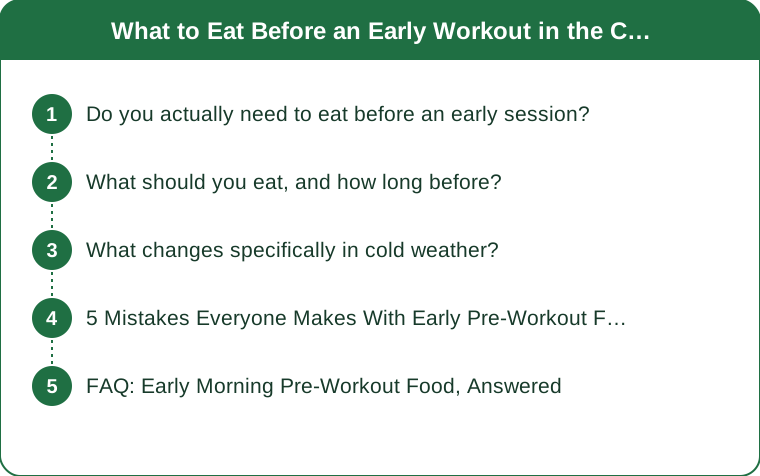
Do you actually need to eat before an early session?
It depends almost entirely on the length and intensity of the session, not on the time of day.
For a session under an hour at easy to moderate intensity, most people perform perfectly well without eating. Your muscle and liver glycogen stores are sufficient, and the discomfort of eating and then immediately exercising is a real cost.
For sessions over an hour, or any hard session, eating beforehand helps. Overnight fasting depletes liver glycogen in particular, and a hard early session on empty tends to feel disproportionately difficult in the final third.
Individual variation is substantial. Some people genuinely cannot eat before morning exercise and perform fine; others feel light-headed without something. Both are normal, and the way to find out is to test it in training rather than reading about it.
Two things that shift the answer toward eating something:
- Cold conditions, which raise energy expenditure modestly through shivering and thermoregulation before you warm up
- Any session with a hard element - intervals, heavy lifting, a race
And one that shifts it the other way: if eating early makes you nauseated and the session is short, do not force it. A short easy session fasted is a perfectly reasonable choice, and it is what a great many people do.
What should you eat, and how long before?
Carbohydrate, low in fat and fibre, with the amount scaled to how much time you have.
The timing principle: the closer to the session, the smaller and simpler the food. Digestion takes blood flow that your muscles want.
60 to 90 minutes before - a proper small meal, 30 to 60g carbohydrate:
- Porridge made with milk or water, with honey and a banana
- Two slices of toast with jam and a small yoghurt
- A bowl of low-fibre cereal with milk
- Overnight oats made without too much added fat
20 to 30 minutes before - small and simple, 15 to 30g carbohydrate:
- Half a banana, or a whole one
- A slice of toast with honey
- Three or four dates
- A small glass of juice
Under 15 minutes - liquid or nothing:
- A sports drink, or juice diluted with water
- Nothing at all, for a short easy session
What to keep low beforehand: fat, fibre, and very large volumes. All three slow gastric emptying, and a slow-emptying stomach during exercise is what causes the discomfort people blame on the food itself.
Protein before an early session is not necessary for a short one, and is worth including if the session is long or if it will be a while before you eat properly afterward. Keep it modest - a large protein and fat breakfast sits heavily.

What changes specifically in cold weather?
Energy demand rises modestly, thirst drops significantly, and warming up takes longer.
Energy expenditure increases somewhat in the cold, from shivering before you warm up and from the general cost of thermoregulation. The effect is modest for most recreational sessions but is real, and it is one more reason to eat something before a long cold session.
Thirst is blunted in cold conditions. This is well documented and it is the more important effect. People drink considerably less in cold weather while still losing fluid through sweat under layers and through respiration - and the visible breath on a cold morning is fluid leaving your body.
What to do about it:
- Drink something warm before you go out - it is more appealing than cold water and it counts.
- Take fluid with you on anything over about an hour, even when you do not feel thirsty, and even in winter.
- Insulated bottles matter in genuinely cold conditions, where a standard bottle can partly freeze.
The warm-up takes longer in the cold, which changes how the pre-session food should be timed. A longer warm-up means more time between eating and the hard part of the session, which is convenient - you can eat slightly closer to the start than you would in summer.
And something warm before an early cold session helps in a way that is not purely physiological. A hot drink and a small warm bowl makes leaving the house at 6am in October considerably more likely to happen, which is the variable that actually determines whether the session gets done.
5 Mistakes Everyone Makes With Early Pre-Workout Food
Mistake 1: Eating a normal breakfast 15 minutes before. A full breakfast with eggs, fat, and fibre needs a long time to clear. Eaten immediately before a session, it produces exactly the heaviness and nausea that make people conclude they cannot eat before training.
Mistake 2: High fibre before a run. Bran, large amounts of raw fruit, and high-fibre cereals are excellent foods at other times. Immediately before running they are a common and entirely avoidable cause of digestive distress.
Mistake 3: Trying something new on race morning or before a hard session. The classic error. Test every pre-session meal in ordinary training first, several times, before it matters.
Mistake 4: Skipping fluid because it is cold. The third mistake is well known, but this is the one that quietly ruins winter sessions. Cold blunts thirst while you continue losing fluid, and mild dehydration in winter is more common than in summer precisely because nobody notices it.
Mistake 5: Eating nothing before a long or hard session because fasted training is fashionable. Fasted training has a place for easy aerobic work. Applying it to intervals, long runs, or heavy lifting generally reduces the quality of the session, which is the thing you are actually trying to improve.
If you have diabetes, any condition affecting blood sugar, or you are pregnant, the guidance around fasted exercise is different and individual. Speak to your clinician. This is general information, not medical advice.
FAQ: Early Morning Pre-Workout Food, Answered
Is fasted training better for fat loss?
The research does not support a meaningful advantage for body composition over the medium term. Total energy intake matters far more. Fasted easy sessions are fine if you prefer them; they are not a shortcut.
What if I feel sick when I eat that early?
Go smaller and more liquid - juice, a sports drink, or half a banana. Many people who cannot manage solid food early can manage something drinkable.
Should I have coffee before a morning workout?
Caffeine reliably reduces perceived effort and improves performance for many people. If you tolerate it and it does not upset your stomach, it is one of the better-supported pre-session choices.
How soon should I eat afterwards?
Within a couple of hours for most purposes, with protein and carbohydrate. The urgency of the immediate post-workout window is smaller than it was once thought to be, unless you are training again the same day.
Does cold weather burn more calories?
Modestly, mainly through shivering before you warm up. The effect is small once you are exercising and generating heat, and it is not a meaningful training strategy.
TL;DR:
- Under an hour, easy to moderate: nothing, or something small 20 to 30 minutes before
- Longer or harder: 30 to 60g carbohydrate, 60 to 90 minutes before, low in fat and fibre
- Cold blunts thirst while you keep losing fluid - drink something warm before and carry fluid over an hour
- Never test a new pre-session meal on a day that matters
- Fasted training suits easy aerobic work and undermines hard sessions
The practical version is short: match the size of what you eat to the time you have, keep it simple, and have something warm before you go out. Most of the difficulty with early autumn sessions is getting out of the door at all, and a hot drink and a small bowl does more for that than any specific food choice.
Keep Reading
This article is for general informational purposes only and is not medical advice. Always consult a qualified health professional for guidance specific to you.