The Post-Vacation Breakfast Reset That Takes Three Days
Quick Answer: Two weeks of late, carbohydrate-heavy, generously portioned breakfasts shifts both your hunger timing and your expectations, and the fix is faster than most people assume - about three days. Anchor breakfast to a consistent time, front-load protein to roughly 25 to 30 grams, and eat it within an hour or two of waking. Expect day one to feel unsatisfying and day three to feel normal. The reset is short because hunger timing is largely a learned rhythm rather than a fixed setting.
You are home, back at your own table, eating what you ate all spring, and you are starving before eleven.
The breakfast did not change. What changed is what your morning has been trained to expect for the past fortnight.

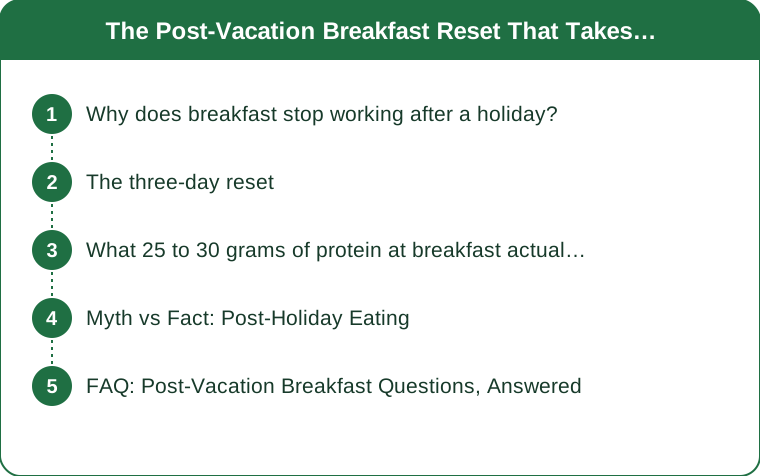
Why does breakfast stop working after a holiday?
Because hunger has a schedule, and yours got rewritten.
Appetite is partly driven by learned timing. Hunger hormones rise in anticipation of when you usually eat, which is why people who normally eat at seven feel hungry at seven even on a day they have skipped. Two weeks of eating at nine or ten shifts that anticipation.
The composition changed too. Holiday breakfasts skew toward refined carbohydrates - pastries, bread, cereal, fruit juice - which digest quickly and produce a shorter satiety window than a protein-heavy meal. If you ate that way for two weeks, your body has been running on a two-hour breakfast rather than a four-hour one.
And portions were probably larger. Buffets and holiday eating shift the reference point for what a normal-sized breakfast looks like, and a return to your usual portion genuinely registers as less.
There is a sleep component as well. Holiday sleep patterns are often later and less consistent, and short or shifted sleep raises appetite - particularly for carbohydrate-dense food - which persists for several days after the schedule returns.
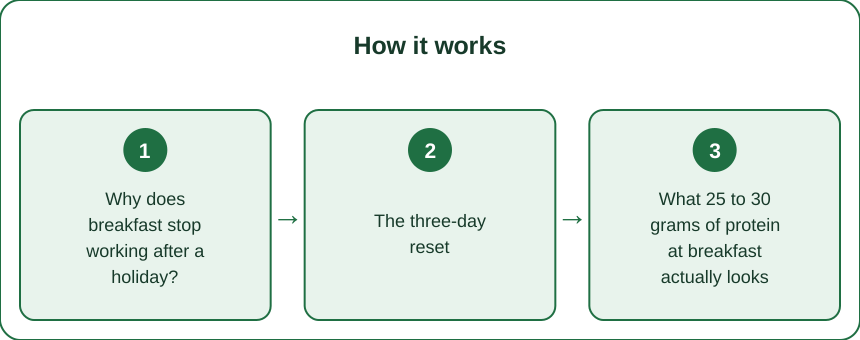
The three-day reset
Day 1 - fix the timing. Eat breakfast within an hour or two of waking, at the time you intend to keep. Do not worry much about the content yet. The single most disruptive thing is the shifted clock, and it responds fastest.
Expect to be hungry at the old time as well. That is anticipatory hunger from the holiday schedule, and it fades.
Day 2 - fix the protein. Aim for 25 to 30 grams at breakfast. This is the change that most affects how long you stay full, and most conventional breakfasts fall far short - a bowl of cereal with milk is often under 10 grams.
Day 3 - fix the rest. Add fibre and some fat: vegetables, whole grains, nuts, seeds. These slow gastric emptying and flatten the blood sugar curve, which is what removes the mid-morning crash rather than just the hunger.
By day three most people report that breakfast holds until lunch. If it does not, the usual culprit is the protein number - it is worth actually counting for a couple of days rather than estimating, because almost everyone estimates high.

What 25 to 30 grams of protein at breakfast actually looks like
This is the part people find genuinely surprising, because the intuitive breakfast is much lower in protein than it appears.
Rough figures for common options:
- Two large eggs: about 12 grams
- Greek yoghurt, 170g: about 15 to 17 grams
- Cottage cheese, 150g: about 15 to 20 grams
- Two slices of wholegrain toast: about 8 grams
- Porridge made with milk: about 10 to 12 grams
- A scoop of protein powder: 20 to 25 grams
So two eggs on toast lands around 20 grams, which is respectable and slightly short. Two eggs, toast, and a small yoghurt clears 30 comfortably.
Combinations that work without much effort:
- Greek yoghurt with berries, nuts, and seeds
- Eggs on toast with a side of cottage cheese
- Overnight oats made with milk plus protein powder
- Leftover dinner protein with an egg - genuinely the fastest option, and there is nothing wrong with it
The practical point: hitting the number almost always requires two protein sources rather than one.
Myth vs Fact: Post-Holiday Eating
Myth: You need to compensate for two weeks of holiday eating. Fact: Two weeks does not undo months of habits, and attempting a corrective restriction usually produces a hungrier, less stable week rather than a better one. Return to normal; do not overshoot.
Myth: You should skip breakfast to reset. Fact: If your goal is to fix mid-morning hunger and energy, skipping the meal that anchors the morning is an odd way to do it. Some people do well on later eating windows generally, but that is a separate long-term choice, not a reset strategy.
Myth: The morning hunger means your metabolism changed. Fact: Two weeks of holiday does not meaningfully change metabolic rate. What changed is meal timing, meal composition, portion expectation, and sleep - all of which are behavioural and all of which reset within days.
Myth: Fruit juice with breakfast is a good way to start the day. Fact: Liquid sugar without fibre produces a fast rise and a fast fall, and it contributes essentially nothing to satiety. Whole fruit is a different proposition entirely.
Myth: You have to enjoy breakfast less for it to work. Fact: A high-protein breakfast can be genuinely good food. The reset that lasts is the one you would choose to eat, not the one you tolerate.
FAQ: Post-Vacation Breakfast Questions, Answered
How long until morning hunger feels normal again?
Usually three to five days for timing, and about a week for the whole pattern including energy levels. If it is still off after two weeks, the issue is more likely to be the current breakfast than the holiday.
What if I genuinely am not hungry in the morning?
Then start small rather than forcing a large meal - a yoghurt or a smoothie with protein. Appetite in the morning is partly trained, and it tends to build over a week or two of consistent eating. Forcing a large breakfast on day one usually backfires.
Does coffee count as breakfast?
Caffeine mildly suppresses appetite, which is why coffee-only mornings feel fine until eleven and then fall apart. It delays the hunger rather than removing the need.
Should I weigh or track food during the reset?
Counting protein for two or three days is genuinely useful, because most people substantially overestimate it. Tracking everything indefinitely is usually unnecessary for a timing-and-composition fix like this one. This is general information, not medical advice.
TL;DR:
- Holiday breakfasts shift timing, composition, and portion expectation - all three drive the mid-morning crash.
- Day 1: fix the time. Eat within an hour or two of waking, at the time you intend to keep.
- Day 2: hit 25 to 30 grams of protein, which usually needs two protein sources, not one.
- Day 3: add fibre and fat to flatten the curve and remove the crash.
- Cereal and toast breakfasts often land under 10 grams of protein - count for two days rather than estimating.
- Do not try to compensate for the holiday. Return to normal rather than overshooting.
Three days is genuinely all it takes, which is worth knowing before you conclude something larger has gone wrong.
Keep Reading
This article is for general informational purposes only and is not medical advice. Always consult a qualified health professional for guidance specific to you.