The Second Coffee Is Eating Your Breakfast - and Your Afternoon
Quick Answer: Caffeine has a modest appetite-suppressing effect, so a second coffee at 10am can make breakfast feel unnecessary right up until it stops working - typically early afternoon, when hunger arrives all at once alongside a genuine energy dip. The fix isn’t cutting coffee. It’s eating protein before the second cup, so the suppression is masking a meal you already had rather than replacing one you didn’t.
You weren’t hungry at eight, you had a coffee at ten, and by two o’clock you’d eat the furniture. This is a sequence, not a coincidence.

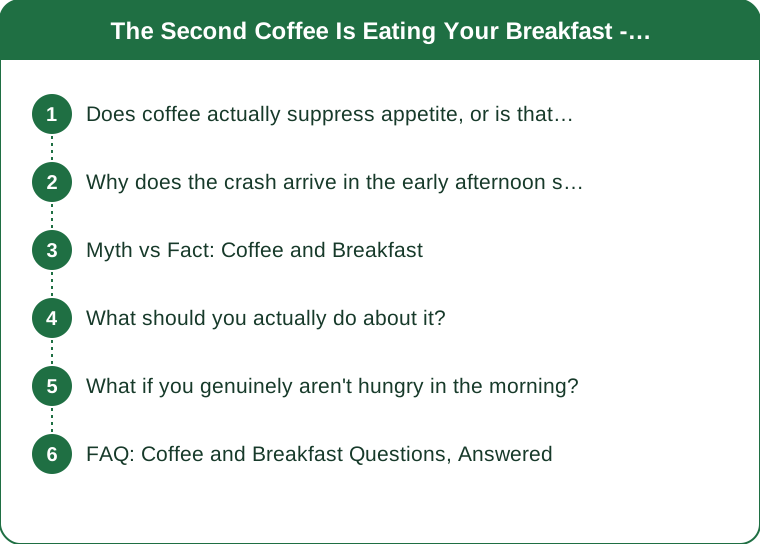
Does coffee actually suppress appetite, or is that a myth?
It has a real effect, and it’s smaller and shorter than the internet suggests.
Caffeine has a modest, short-lived appetite-suppressing effect that’s been observed across a number of studies. The proposed mechanisms include effects on hormones involved in hunger and satiety signalling, and a small increase in metabolic rate. The effect is genuine and it’s measured in hours, not in a whole day.
What this means practically: a coffee can push hunger back by a couple of hours. It doesn’t remove the need for the food, and the research on caffeine reducing overall daily intake is not compelling - people who skip breakfast because of coffee generally eat the calories later.
The bigger issue isn’t total intake anyway - it’s timing. Pushing your first real food from 8am to 2pm means:
- A six-hour gap where blood sugar and energy are running on last night’s dinner
- A large meal eaten in a state of significant hunger, which reliably means eating faster and more than intended
- Compressed eating in the second half of the day, which for many people means eating close to bedtime
And there’s a specific trap in the pattern. Coffee’s appetite effect fades while its stimulant effect is still going, so you can feel alert and unhungry at 11am and be running on genuinely low fuel - which is a state most people misread completely.
Why does the crash arrive in the early afternoon specifically?
Three things converge at roughly the same hour, and they’re often mistaken for one thing.
1. The appetite suppression wears off. Caffeine’s half-life is commonly cited as around 4-6 hours in most adults, but its appetite effect fades considerably faster. A 10am coffee’s hunger-blunting is largely gone by early afternoon while the caffeine itself is still circulating.
2. The post-lunch dip is real and independent of what you ate. There’s a well-documented natural dip in alertness in the early afternoon, driven by circadian rhythm. It happens whether or not you eat lunch, which is why blaming the sandwich is usually wrong.
3. If you finally eat, you eat a lot, fast. Arriving at lunch after 18 hours without protein means a bigger meal eaten quickly. A large, rapidly-eaten, carbohydrate-heavy meal after a long fast produces a bigger blood sugar swing than the same food eaten in a less depleted state.
Stack those three and the 2pm collapse is almost engineered. You’ve got the natural circadian dip, plus the end of caffeine’s masking effect, plus a big glucose swing from a meal eaten in a hole.
And the standard response makes it worse: another coffee at 2pm. That’s now within the window where caffeine can affect sleep quality for many people, since it takes hours to clear - and worse sleep means a harder morning, which means more coffee. The loop closes.
Myth vs Fact: Coffee and Breakfast
Myth: Coffee on an empty stomach damages your stomach lining. Fact: For most people without an existing condition, coffee on an empty stomach doesn’t cause damage. It does increase stomach acid production, which can be uncomfortable if you’re prone to reflux or gastritis - a comfort issue rather than an injury one. If it hurts, that’s worth listening to.
Myth: Coffee dehydrates you and doesn’t count as fluid. Fact: At typical intakes the diuretic effect is mild, and coffee contributes to daily fluid intake. It isn’t the dehydration villain it’s frequently made out to be.
Myth: Skipping breakfast is fine because intermittent fasting works. Fact: Time-restricted eating is a legitimate approach that suits some people well. The problem isn’t skipping breakfast deliberately - it’s skipping it accidentally because coffee masked the hunger, which is an unplanned fast you didn’t choose and don’t compensate for.
Myth: You need to eat within an hour of waking. Fact: There’s no universal requirement. What matters is whether the pattern works for you - your energy, your afternoon, and whether you end up eating in a rush at 2pm.
Myth: Black coffee has no effect because it has no calories. Fact: Caffeine has physiological effects independent of calories - on alertness, hunger signalling, cortisol, and heart rate. Zero calories is not zero effect.
Myth: The afternoon crash means you need more caffeine. Fact: The crash is usually some combination of the circadian dip, a large glucose swing, and inadequate fuel. More caffeine masks the symptom and worsens the sleep that caused half of it.

What should you actually do about it?
Four changes, in order of effort. Most people only need the first two.
1. Put protein before the second coffee. Not necessarily a full breakfast - 20-30g of protein is the useful target, and it can be small and unceremonious. Greek yoghurt, two eggs, a protein shake, cottage cheese on toast, leftovers. Protein is the most satiating macronutrient and has the smallest effect on blood glucose, which makes it exactly the right thing to put in the gap.
The rule that does the work: coffee after food, not instead of it. You can keep every cup you currently drink.
2. Move the second coffee later. If your first is at 7am and your second at 10am, shifting the second to 11.30 after you’ve eaten something changes the whole afternoon. The 10am cup is the one doing the damage because it arrives exactly when genuine hunger would otherwise show up.
3. Set a caffeine cut-off. Commonly suggested is around eight hours before bed, though sensitivity varies enormously between individuals. If you sleep badly and drink coffee after 2pm, that’s the experiment worth running for a fortnight.
4. Eat something before the first coffee if mornings are rough. For people who feel jittery, anxious, or nauseated on morning coffee, even a small amount of food first frequently resolves it.
Realistic breakfasts that take under three minutes and hit 20g of protein:
- Greek yoghurt with berries and a spoon of nut butter - around 20g, no cooking
- Two eggs, any method - around 12g, add cheese or a slice of ham to close the gap
- Cottage cheese on toast - around 15-20g depending on portion
- A protein shake with milk - 25-30g, and the option for people who genuinely can’t face food
- Overnight oats with protein powder or Greek yoghurt - made the night before, eaten cold
None of these require you to become a morning person. They require thirty seconds and something in the fridge.
What if you genuinely aren’t hungry in the morning?
Common, normal, and worth distinguishing from coffee-masked hunger.
Genuinely low morning appetite has several ordinary explanations: eating a late or large dinner, individual variation in hunger-hormone rhythms, some medications, and simple habit - appetite is partly trained, and a body that hasn’t been fed at 8am for years stops asking.
The distinguishing test: for one week, have your morning coffee at your usual time and pay attention at 10am and 11am. If hunger appears once you’d normally have had the second cup, the appetite was there and being suppressed. If nothing appears all morning, your morning appetite is genuinely low.
If it’s genuinely low, options that work:
Drink your protein. A shake or a milk-based drink is far easier when solid food is unappealing, and it delivers the same result.
Eat a smaller earlier meal and a proper mid-morning one. Ten grams at 8am and a real meal at 10.30 beats nothing until 2pm.
Shift dinner earlier. A meal finished at 7pm rather than 9.30pm makes a substantial difference to morning appetite within about a week.
Or simply eat later, on purpose. A deliberate 12pm first meal with adequate protein, eaten calmly, is a completely reasonable pattern - it’s the accidental version, driven by caffeine and ending in a rushed 2pm binge, that causes problems.
When it’s worth mentioning to a doctor: a persistent, unexplained loss of appetite, unintentional weight loss, nausea that’s new, or morning appetite loss alongside other symptoms. This is general information, not medical advice.
FAQ: Coffee and Breakfast Questions, Answered
How much coffee is too much?
Commonly cited guidance puts up to about 400mg of caffeine a day - roughly four cups of brewed coffee - as acceptable for most healthy adults. Individual sensitivity varies widely, and pregnancy has lower recommended limits.
Does adding milk to coffee count as eating?
A splash doesn’t. A large milky coffee provides some protein and calories and genuinely blunts hunger more than black coffee - which is helpful for comfort and still well short of a meal.
Should I eat before or after my morning workout?
Both work depending on the session and how you feel. For anything longer or harder than a gentle session, eating something beforehand generally makes it go better - and coffee-only is the version most likely to leave you flat.
Is the afternoon crash always about food?
No. There’s a genuine circadian dip in early-afternoon alertness that happens regardless of what you eat. Food timing changes its depth, not its existence.
TL;DR:
- Caffeine’s appetite suppression is real, modest, and wears off in a couple of hours
- The 10am coffee masks genuine hunger, so first food lands at 2pm in a hole
- Three things converge in the early afternoon: the circadian dip, the end of suppression, and a big fast glucose swing
- Coffee after food, not instead of it - 20-30g of protein before the second cup
- Set a caffeine cut-off; the 2pm rescue coffee costs you the sleep that caused the morning
Keep the coffee. Move the protein in front of it.
Keep Reading
This article is for general informational purposes only and is not medical advice. Always consult a qualified health professional for guidance specific to you.