Does Eating Breakfast Later Actually Help? What Shifting the Timing Changes
Quick Answer: Shifting breakfast later works for some people mainly by reducing total eating window and cutting one snack occasion, not through anything special about the clock. Appetite hormones do adjust to a habitual schedule within roughly a week or two, so the first days of hunger are not a verdict. Where it clearly helps: if you were eating without hunger out of habit, or grazing through the morning. Where it clearly does not: if you train early, if delaying leads to a large or poorly composed meal, or if it pushes your last meal of the day later.
The advice sounds elegant - hold off until 10, ride the natural cortisol rise, eat when you are actually hungry. For some people it works well. For others it produces a ravenous 11am and a worse afternoon than the one they were trying to fix.

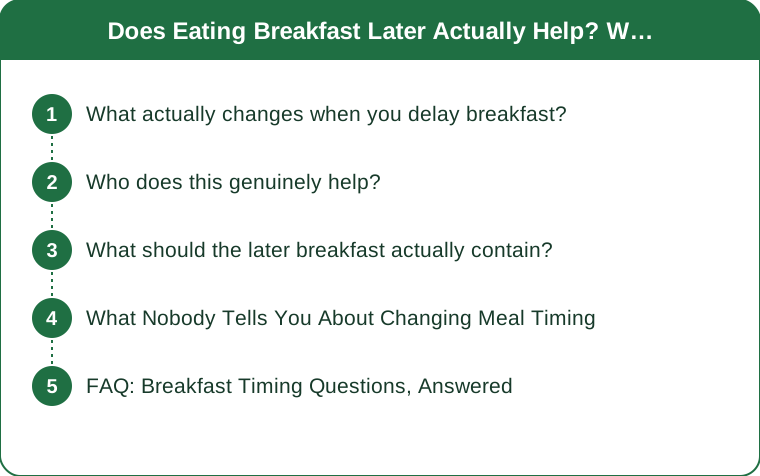
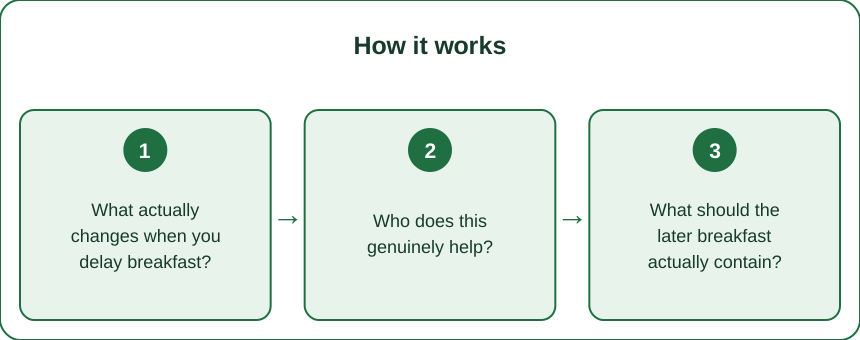
What actually changes when you delay breakfast?
Several things, and they are not equally important.
Your eating window shortens. If you were eating at 7am and finishing at 8pm, that is thirteen hours. Move breakfast to 10 and it becomes ten. Most measured benefits of time-restricted eating in trials appear to come from the shortened window and the reduction in total intake, not from the specific hour breakfast lands on.
One eating occasion often disappears. The 10am pastry with coffee stops happening because you just ate. For a lot of people this is the entire effect, and it is a real one.
Hunger hormones reschedule. Ghrelin, the main hunger signal, rises in anticipation of habitual meal times - it is trained by your schedule, not fixed. When you change the schedule, it takes roughly one to two weeks to retrain. The hunger you feel on day three is your old schedule still firing, and it is the single most common reason people abandon the change one week before it would have worked.
Morning fat oxidation increases modestly in the fasted state. Meaningful for metabolic research, largely irrelevant to body composition over a day, since what matters is total energy balance rather than which fuel you burned before 10am.
Who does this genuinely help?
Four groups, fairly reliably.
People who eat breakfast without being hungry. If you have been eating at 7 because breakfast is important rather than because you wanted it, delaying to actual hunger usually improves both appetite regulation and how much you enjoy the meal.
Morning grazers. Coffee, then a banana, then something at the desk, then a snack before lunch. Consolidating that into one substantial meal at 10 nearly always reduces total intake and produces steadier energy.
People with an early-evening habit of overeating. Slightly counterintuitive, but a properly composed later breakfast that actually satisfies often reduces the 4pm and 9pm raids more than an early small breakfast did.
People whose mornings are chaotic. If breakfast at 7 means eating standing up in two minutes, a real meal at 10 at a desk is a better meal and a better experience.
Who it does not help
- Anyone training before 9am. Fasted work is fine for easy sessions and noticeably worse for hard or long ones. If your morning session matters, eat something before it.
- People who get genuinely hypoglycemic symptoms - shakiness, irritability, a headache by 9am. That is a signal to eat, not a habit to override.
- Anyone with a history of restrictive eating. Delaying meals can slot straight into a restriction pattern, and the risk outweighs a modest metabolic effect.
- People who end up eating later at night as a result. Shifting the whole window later tends to work against you, since eating close to bedtime is more consistently associated with poorer glucose handling and sleep.

What should the later breakfast actually contain?
This is where the strategy is most often lost. Waiting until 10 and then eating toast and jam produces a worse blood sugar and appetite profile than eating a balanced meal at 7 would have.
After a longer overnight fast, composition matters more, not less:
- 30 to 40 g protein. This is the number that governs satiety through to lunch. Three eggs plus a portion of cottage cheese, a large Greek yogurt with added protein, or leftover chicken and grains.
- Fiber, 8 to 10 g. Oats, berries, beans, or vegetables. Blunts the glucose response and extends fullness.
- Some fat. Nuts, avocado, olive oil, or whole eggs - slows gastric emptying.
- Carbohydrate matched to your morning. If you trained, more. If you sat at a desk, less.
A concrete example: three scrambled eggs with spinach, half an avocado, and a slice of dense rye - roughly 30 g protein, 9 g fiber, and it holds most people comfortably to 1pm.
The coffee question
Black coffee does not break the fast in any way that matters here. But coffee on an empty stomach at 7 followed by nothing until 10 makes some people jittery and others nauseated, and it can amplify the cortisol response some people are sensitive to. If that is you, delay the coffee too - or have it with the meal rather than three hours before.
What Nobody Tells You About Changing Meal Timing
The adjustment period is real and it is short. Days two through six are the worst. Ghrelin is still firing on the old schedule. If you evaluate the experiment on day four, you will conclude it does not suit you, and you will be evaluating an adjustment, not the strategy.
Consistency beats the specific hour. Irregular meal timing appears to be worse for glucose handling than any particular timing. Eating at 10 every day beats alternating between 7 and 11 - which means the best schedule is usually the one you can actually repeat on a Wednesday and a Saturday.
It interacts with your sleep schedule, not the clock on the wall. Delaying breakfast by three hours means something different if you wake at 5 than if you wake at 8. Think in hours after waking rather than in absolute times: for most people the useful frame is eating two to four hours after waking rather than at a fixed hour.
Late-day appetite is the honest scoreboard. Track evening hunger for two weeks. If delaying breakfast makes 8pm easier, it is working. If you are eating more after 6pm than you used to, the window moved rather than shortened, and the benefit has been reversed.
It is not a large effect on its own. Meal timing is a lever, not an engine. Total intake, protein, sleep, and movement outrank it comfortably. If the timing change is the only thing changing, expect a modest result.
FAQ: Breakfast Timing Questions, Answered
Will delaying breakfast slow my metabolism?
No. The idea that skipping or delaying meals slows metabolism does not hold at the timescales involved here - resting metabolic rate is not meaningfully affected by a few hours. What can change is spontaneous movement: some people move less when underfed in the morning, which reduces daily energy expenditure through the back door.
Is it different for women?
Some evidence suggests women’s appetite and hormonal responses to fasting periods differ, and reports of disrupted cycles with aggressive fasting protocols are not rare. A three-hour delay is mild and unlikely to cause issues for most, but if your cycle changes, sleep worsens, or training quality drops, that is meaningful feedback rather than something to push through.
What if I am hungry at 7 but not at 10?
Then eat at 7. Genuine morning hunger is useful information, not a habit to defeat. The strategy is aimed at people eating without appetite; forcing it on someone with real morning hunger is solving a problem they do not have.
Does it matter more as the days get shorter?
Possibly. Light exposure anchors circadian rhythm, and morning light is a stronger signal than meal timing. As mornings get darker into autumn, getting outside shortly after waking probably does more for your energy than moving breakfast around does. Do the light first, then experiment with the food.
This is general information, not medical advice - particularly if you take medication with meals or manage a blood sugar condition.
TL;DR:
- Most of the benefit comes from a shorter eating window and one fewer snack, not from the hour itself.
- Give it 10 to 14 days. Ghrelin runs on your old schedule and retrains slowly - day four is not the verdict.
- A later breakfast needs more structure, not less: 30 to 40 g protein, 8 to 10 g fiber, some fat.
- Skip it if you train early, get genuinely shaky, have a restriction history, or end up eating later at night.
- Evening hunger is the scoreboard. Easier at 8pm means it worked; harder means the window just moved.
Breakfast timing is a small lever that happens to be easy to pull. Pull it if the shape of your morning fits - and if it does not, the same energy spent on protein at whatever hour you actually eat will do more.
Keep Reading
This article is for general informational purposes only and is not medical advice. Always consult a qualified health professional for guidance specific to you.