30 Grams of Protein at Breakfast Without Eating Eggs Every Single Day
Quick Answer: Six builds reliably clear 30 grams without an egg in sight: a Greek yogurt power bowl, cottage cheese toast, protein oats, a smoothie built on milk and powder, a tofu scramble, and the unfairly effective leftovers-for-breakfast move. The system matters more than the recipes - two defaults you rotate on autopilot, one two-minute backup for chaotic mornings, and the willingness to treat protein powder as an ingredient rather than a supplement.
The morning protein gap is the most common hole in otherwise decent eating: coffee plus a carb until noon, then a day spent chasing the deficit. Eggs solve it until the third consecutive week of eggs, at which point most people quietly go back to toast. The fix is not more discipline. It is a bench deep enough that no single food carries the season.

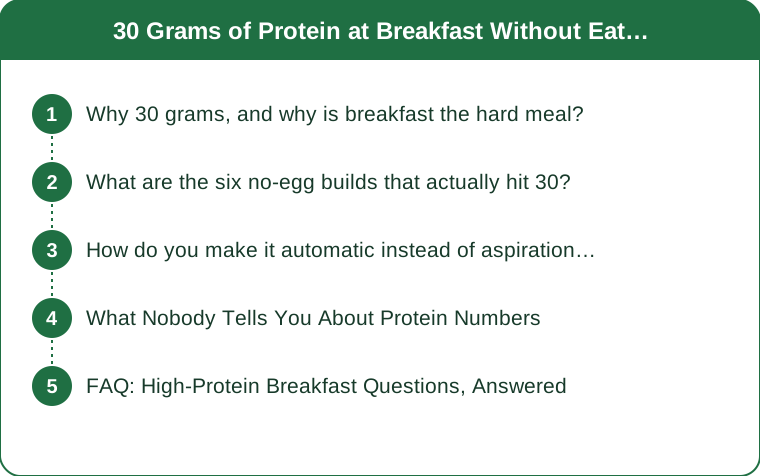
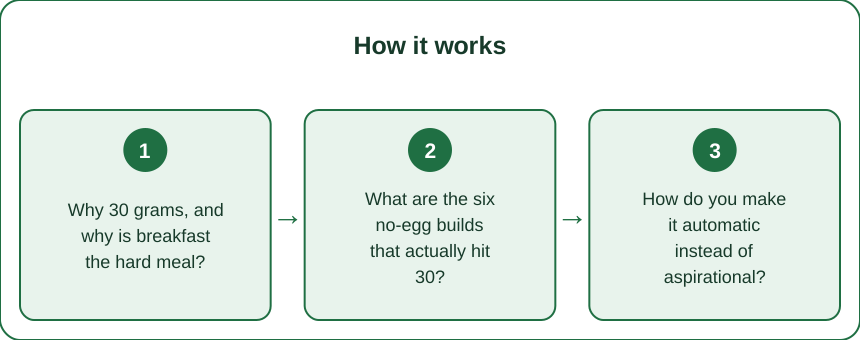
Why 30 grams, and why is breakfast the hard meal?
The 30-gram figure is not a magic threshold, but it is a well-chosen target: in the range of 25 to 30 grams, a meal delivers enough of the key amino acids to meaningfully switch on muscle repair and maintenance - which matters whether the goal is training recovery, keeping muscle while losing weight, or aging well. It also buys the practical prize: satiety. A 30-gram breakfast is the single most reliable fix for the 10:30am snack drift and the afternoon vending-machine arc.
Breakfast is the hard meal because the default American morning is structurally protein-poor. Cereal with milk lands near 10 grams. Toast with butter, 4. Oatmeal alone, 5. A pastry with coffee, almost nothing. Dinner protein takes care of itself in most households; breakfast has to be engineered.
Distribution is the other half of the argument. The same daily total works harder spread across meals than crammed into dinner, which is where most of it currently lives. Front-loading 30 grams moves the whole day’s eating pattern - less grazing, steadier energy, an easier time hitting the total without a 9pm protein scramble.
And the egg problem is real: at 6 grams each, the 30-gram breakfast is a five-egg breakfast. Nobody sustains that. Eggs are a rotation member, not a foundation.
What are the six no-egg builds that actually hit 30?
1. The Greek yogurt power bowl - the workhorse. One cup of plain Greek yogurt (about 17 to 20g) plus two tablespoons of hemp seeds (6g) plus a quarter cup of granola (3 to 4g) plus berries. Total: 27 to 30g, five minutes, no heat. Skyr runs even higher per cup.
2. Cottage cheese toast - the sleeper hit. Three-quarter cup of cottage cheese (about 20g) on a slice of high-protein or whole grain toast (5 to 10g), finished sweet with berries or savory with tomato, pepper, and everything seasoning. Total: 25 to 30g.
3. Protein oats. Half a cup of oats (5g) cooked, then a scoop of protein powder stirred in off the heat, plus milk (4g) and a spoon of peanut butter (4g). Total: 33 to 38g, and it survives the overnight-oats format for grab-and-go weeks.
4. The smoothie that counts. Milk or soy milk base (8g), a scoop of powder (20 to 25g), frozen fruit, a handful of spinach nobody tastes. Total: 28 to 33g, drinkable in the car.
5. Tofu scramble. Half a block of firm tofu (about 15 to 20g) crumbled into a hot pan with turmeric, garlic powder, and whatever vegetables exist, plus a sprinkle of nutritional yeast (4g) and toast. Total: 25 to 30g, and the best savory option on the list.
6. Leftovers, unapologetically. Last night’s chicken and rice, the salmon, the chili - dinner food is breakfast food with better macros. Total: usually 30g+ with zero new cooking. Cultures worldwide eat savory dinners at breakfast; the cereal aisle is the anomaly.

How do you make it automatic instead of aspirational?
The rotation fails when it requires morning decisions, so remove them.
Run the two-defaults system. Pick one no-cook build (yogurt bowl) and one warm build (protein oats or scramble) as this month’s defaults, and buy for them on repeat. Alternate by mood without thinking. Swap one default monthly to stay ahead of boredom - the same principle that keeps eggs from collapsing keeps yogurt from collapsing.
Install the two-minute backup. Some mornings detonate on schedule contact. The backup is shelf-stable and assembly-only: a shake plus a banana, or cottage cheese straight from the tub with a handful of granola. The rule is that the backup lives visible at eye level - the front of the fridge shelf is prime behavioral real estate, and whatever occupies it gets eaten on the chaotic days.
Prep in five-minute windows, not project mode. Overnight oats in two jars while dinner cooks. Berries washed once, eaten thrice. A smoothie bag - fruit, spinach, seeds pre-portioned - per freezer slot, so morning-you adds liquid and presses a button.
And late-summer mornings favor the cold half of the bench anyway: the yogurt bowl, the overnight oats, the smoothie. Save the scramble and hot oats for the first cool mornings of September, when they start feeling like a reward again instead of a radiator.
What Nobody Tells You About Protein Numbers
Labels are per serving, and servings are fiction. The yogurt tub says 15 grams - per serving, which is two-thirds of what anyone puts in a bowl. Weigh or measure once, learn what your actual portion delivers, and the mental math stays honest forever after.
Protein powder in food is cooking, not cheating. A scoop stirred into oats or blended with fruit is nutritionally similar territory to the dairy proteins it sits beside - whey is a milk protein, after all. The supplement framing keeps people from the single easiest lever in the whole breakfast problem.
The plant-milk swap silently deletes protein. Swapping dairy milk (8g per cup) for almond or oat milk (1 to 3g) quietly removes a third of a smoothie’s base. Soy milk (7g) is the plant milk that holds the line - relevant across the whole plant-forward version of this article.
30 is a target, not a tollbooth. A 24-gram breakfast is a fine breakfast; the point is escaping the 8-gram default, not passing inspection. People who treat the number as pass-fail quit; people who treat it as a direction drift upward and stay.
And the effect shows up at 4pm, not 8am. The payoff for the bigger breakfast is invisible until the afternoon, when the snack pull simply is not there. Judge the experiment on a full day, three days running - never on how virtuous the bowl felt.
FAQ: High-Protein Breakfast Questions, Answered
What breakfast has 30 grams of protein besides eggs?
A cup of Greek yogurt with hemp seeds and granola, cottage cheese toast, oats with a scoop of protein powder, a milk-and-powder smoothie, a half-block tofu scramble, or straightforwardly reheated leftover dinner. All land between 25 and 38 grams.
Is it okay to use protein powder every morning?
For most healthy people, a daily scoop as part of varied eating is fine - it is a concentrated food, not a pharmaceutical. Anyone with kidney disease or specific medical guidance should follow their clinician’s advice. This is general information, not medical advice.
Does coffee count against my breakfast protein?
Plain coffee neither adds nor subtracts - but a milk-heavy latte quietly contributes 6 to 10 grams, which is a pleasant accounting surprise in the right direction.
What if I am not hungry in the morning?
Start liquid - the smoothie counts fully - or shift the 30-gram meal to whenever you first genuinely eat. Distribution beats clock-worship: the goal is escaping the all-protein-at-dinner pattern, not eating at dawn on principle.
TL;DR:
- 30 grams by the first meal flips the whole day: better satiety, easier totals, no 4pm graze.
- Six no-egg builds clear the bar: yogurt bowl, cottage cheese toast, protein oats, milk-based smoothie, tofu scramble, leftovers.
- Automate it: two rotating defaults, one visible two-minute backup, powder treated as an ingredient.
- Watch the silent leaks - fictional label servings and the almond-milk swap - and judge results at 4pm, not 8am.
The egg was never the requirement; the grams were. Build a bench of six, let the season pick the cold ones, and the 30-gram breakfast stops being a project and becomes what it should be - the most boring, load-bearing habit in the kitchen.
Keep Reading
This article is for general informational purposes only and is not medical advice. Always consult a qualified health professional for guidance specific to you.